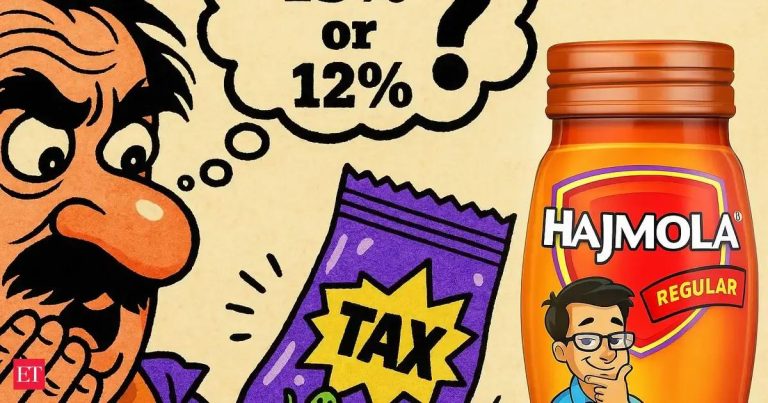
Hajmola in Hot Water: Dabur Faces GST Turmoil | Image Source: m.economictimes.com
NEW DELHI, India, 12 April 2025 – The humble Hajmola, a domestic digestive base in India known for its tangitious coup, is at the center of a growing storm. Again, Dabur India, the company behind the iconic product, is undergoing a thorough review this time by the GST Information Branch (GIB). At the heart of the research, a family problem with significant financial consequences arises: Hajmola is an Ayurvedic medicine, or is it simply a candy?
According to a CNBC-TV report18, the DGGI Coimbatore region is testing whether the popular digester should be imposed under the 12% GST plate applicable to Ayurvedic medicines or at the highest rate of 18% for sweets. Dabur, for its part, remains firm in its position: Hajmola is a patented Ayurvedic formulation and not a conventional sweet manufacture. The company notes the previous ruling of the Supreme Court of Time before the GST, which joined its classification of the product as an Ayurvedic element.
This renewed research not only focuses on Hajmola, but also addresses a broader and more recurring issue within the complex and often ambiguous structure of the four-tier GST in India. Since goods are taxed at rates of 5%, 12%, 18% and 28% according to classification, confusion has become common. Hajmola is now simply the last entry in a long list of products captured in this enveloped web.
What is the central problem behind the TPS probe in Hajmola?
The GST classification system is at the heart of the dispute. If an article is considered medicinal or lenient, it has a significant impact on the tax rate it attracts. Dabur argues that the Hajmola formulation, based on traditional Ayurvedic ingredients such as black salt, cumin, ginger and long pepper, qualifies it as Ayurvedic medicine. As Dabur said, its preparation is aligned with the Ayurvedic pharmacy and is marketed as a digestion aid.
However, tax authorities seem to assess whether Hajmola’s caramel format and its wide appeal as a slate of aperitifs at the medicinal limit. According to the Economic Times, IMB is examining whether the use, packaging and consumption behaviour of the product are similar to candy rather than drugs, justifying the 18% tax increase.
This classification issue is not new. In the period prior to the GST, the Supreme Court ruled in favour of Dabur, declaring Hajmola an Ayurvedic medicine based on its plant content and therapeutic value. This decision allowed Dabur to avoid the highest extreme duty applicable to clothing. Now, under the GST, the same battle is back, only terminology has changed.
Do other products face similar challenges in the classification of the GST?
Yes, the Hajmola case is far from isolated. In recent years, Indian tax authorities have faced several classification dilemmas. Consider:
- Flavored Milk: In November 2023, the Madras High Court ruled that flavored milk falls under the ‘milk and cream’ category (HSN Code 0402), attracting 5% GST, rather than under ’beverages containing milk’ (HSN Code 2202), which attract 12%.
- Frozen Parathas: The Appellate Authority for Advance Ruling (AAAR) held that frozen parathas, which require heating before consumption, should be taxed at 18%, not as simple ‘roti’ which would have attracted only 5%.
- Spice Mixes: Another example involves ready-to-cook spice blends. Authorities argued they should be taxed at 18% under HSN 2103 (‘mixed condiments and seasonings’) instead of 5% under HSN 0910 (‘spices’), based on the proportion of added ingredients.
These cases highlight a persistent grey area in the GST regime, where the function, composition and use of the consumer can be affected to determine the classification of a product. As for Taxscan, the problem is systemic, created by overlapping tax levels and vague classification criteria, often leaving room for interpretation and disputes.
How does this dispute affect Dabur financially?
The GST classification probe is just one of many regulatory challenges facing Dabur India. On April 1, 2025, the company revealed that it had received an income tax reassessment order for fiscal year 2017-2018. The tax authorities demanded Rs 110.33 crore, alleging incorrect deductions related to internal research and development (R plagaamp; D) and pursuant to section 14A of the Income Tax Act 1961.
In parallel with the GST case, this tax claim places Dabur in an adjusted financial position. According to the Hindu Times, Dabur is already anticipating a contraction of operating margins from 150 to 175 basis points due to persistent inflation and harmful urban demand. Its income for the fourth quarter of FY25 is expected to be stable, further weakening investor confidence, resulting in a 7.5% decline in its shares and a 52-week decline.
In addition, Dabur is currently in a separate judicial case. The Delhi High Court asked the company to provide scientific evidence in support of its request for toothpaste that fluorine may harm health. Colgate-Palmolive filed a complaint labeling the claim as misleading and harmful to fluoride-based dental products. The outcome of this case may influence not only Dabur’s marketing practices, but also how health claims are regulated in India.
What is Dabur’s international perspective?
While Dabur fights regulatory fires at home, his international operations remain a relatively bright point. According to its latest financial disclosures, nearly 25% of its revenues come from global markets. Regions such as the Middle East and North Africa (MENA), Egypt and Bangladesh show strong double-digit growth.
This international buoyancy offers some isolation from the pressures of the Indian market. For example, Vatika’s real fruit juices and hair care products have found a solid basis for consumption abroad, helping to maintain a healthy global income stream. But while this growth can completely compensate for internal drag, it remains uncertain.
Dabur should report its proven results for the full fiscal year on May 7, 2025. Market observers are looking closely at the report, including whether Dabur is announcing a final dividend, a signal that could help reassure investors.
Why does Hajmola’s GST business matter beyond Dabur?
It is tempting to see the Hajmola dispute as another tax issue for a single giant FMCG. But it goes back to diapers, and it becomes a case of evidence for India’s treatment of traditional and functional foods at the time of the GST. As ayurveda becomes more popular and well-being foods come to shelves, the line between medicine and consumables becomes more difficult to define.
For example, functional chocolates enriched with herbs, wellness drinks with Ayurvedic roots or protein bars containing adaptogens, all new products that cover several categories. The issue of tax classification will only be more controversial. As the experts cited in The Economic Times say, there is an urgent need to clarify regulations to avoid ongoing litigation and ambiguities.
If DGGI decides that Hajmola is a caramel, it could create a precedent that affects hundreds of similar products. Companies would face higher tax rates or would be forced to reformulate or refocus products to adapt to the preferred tax categories. It could even affect consumer prices and the accessibility of traditional resources for low-income consumers.
What follows Dabur’s legal and regulatory journey?
According to industry experts, Dabur responded to the DGGI consultation, undertaken in its Hajmola classification as Ayurvedic. The society trusts the previous ruling of the Supreme Court, which had been favourable. It remains to be seen whether this precedent remains under the GST Act, which operates on different principles than pre-GST classifications.
The next few weeks will be crucial. Dabur will have to defend his case with documentation, scientific validation and perhaps expert testimony. In the meantime, the GST Board, the judiciary and tax authorities must address the development of consumer products and the impact of taxation on a modern welfare market.
In short, the case of Hajmola is more than just a fiscal entanglement, it is a confrontation between tradition and regulation, between welfare and fiscal control. And the verdict, in any case balanced, is forced to send waves throughout the FMCG landscape.
Take away: As the GST system matures, India faces a fundamental question: how to classify products between food and pharmacy? The case of Hajmola can very well serve as the litmus test for this evolving puzzle.